The excess and surplus lines market shows signs of slowing growth, reflecting broader pressures in the property/casualty sector as competition intensifies.
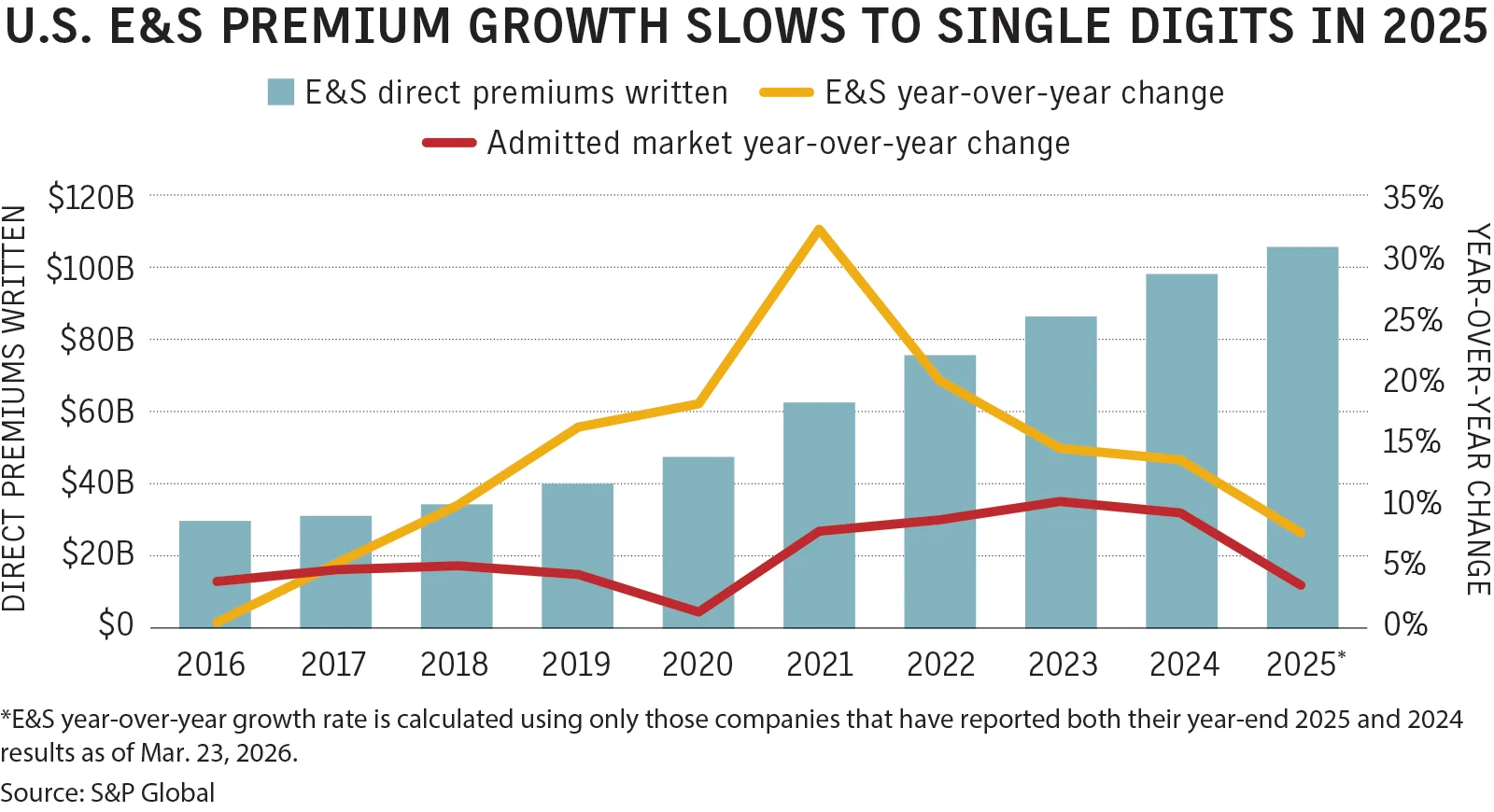
The excess and surplus (E&S) lines market has historically outperformed the wider commercial insurance sector, benefiting from hard-market conditions and stricter underwriting practices. However, recent data indicates a deceleration in this growth, mirroring broader trends within the property/casualty landscape.
Current Trends in E&S Market Growth
As the insurance industry navigates fluctuating market conditions, the E&S lines sector stands at a crossroads. While historically buoyed by stringent underwriting and high demand during hard markets, the latest figures suggest that momentum is waning. For many in the sector, this leads to pressing questions about sustainability. The E&S lines market typically thrives when traditional insurance options are limited, yet recent shifts reveal a more complex reality.
According to the latest rankings by Business Insurance, the ten largest property/casualty wholesalers saw written premiums increase by just 1.8% in 2025. This modest growth places the E&S lines market in a precarious position. When compared to previous years, the recent uptick feels more like a deceleration. Nonadmitted direct premiums within the top surplus lines insurers experienced a slightly higher increase of 3.3%. Though this appears healthier at first glance, it's still a significant retreat from previous growth patterns.
Notably, S&P Global Market Intelligence reported that E&S direct premiums surpassed $100 billion for the first time in 2025, reaching $105.3 billion. But here's the catch: this represents a disappointing growth rate of 7.8%, which reflects the first instance of single-digit growth since 2018. The figures prompt skepticism about whether the E&S lines market can maintain its lead amidst emerging competitive pressures.
Shifting Dynamics in Property and Homeowner Markets
Commercial property insurance, once heralded as the primary driver of market expansion, is now a source of concern. Increasing competition has caused a decline in rates, leading many insurers to reevaluate their strategies. It's an environment that invites scrutiny. If commercial properties are faltering, what does that mean for the broader risk assessments in the E&S bracket?
Contrastingly, the homeowners market displays resilience. Capacity constraints in areas prone to natural disasters have funneled more risks into the nonadmitted market, which might offer higher premiums compared to traditional options. This shift provides a counterbalance that industry analysts might want to keep an eye on. Will more homeowners seek solace in the E&S framework as traditional insurers retract their coverage? A valid question, indeed.
Detailed Segmentation Analysis
Data from the Wholesale & Specialty Insurance Association’s recent report emphasizes shifts in premium allocation within the segment. Liability (non-professional) remains the leading segment of the surplus lines market, comprising 39.6% of total premiums, which rose by 11.2% to $18.8 billion. The sustained interest in liability coverage showcases a market that still has appetite and engagement. But it's crucial to weigh this against the significant drop in the property segment, which experienced a 13.7% decline, bringing its volume down to $13.6 billion or 28.5% of total premiums.
This contrast highlights a growing uncertainty in property coverage, especially as emerging risks evolve. While liability coverage has solid ground, the property sector's performance will weigh heavily in future strategic planning for E&S insurers. If you're working in this space, understanding these nuances could help in adapting to potential shifts.
The Homeowners and Personal Property Surge
Interestingly, premiums for residential homeowners and other personal property surged by 20.2%. This ascendancy aligns with the strategic shifts noted earlier, where shifts in risk pooling toward the E&S market create opportunities for insurers. In addition to personal lines, professional liability premiums rose by 15% and auto liability by 15.8%. These figures present a landscape where, despite an overall slowdown, specific segments still show real potential.
Overall premium volume from states with surplus lines stamping offices increased by 2.8% in the first half of the year, totaling $47.6 billion. But this marks a stark decline from the 13.2% growth recorded the previous year. The discrepancy is telling and likely indicates that the market is stabilizing or even contracting in certain areas.
Regional Performance Variability
Regional performances also tell a compelling story. Despite the slower premium growth, policy filings showcased a healthy increase of 16.9%, suggesting robust submission activity remains intact. But variability is the name of the game: Florida, the second-largest surplus lines market, reported a 5.6% decline in premiums despite a 14.4% rise in filings. Meanwhile, Oregon faced an 18.8% drop, while Idaho emerged as a surprise with impressive premium growth of 25.5%. This juxtaposition serves as a reminder of the volatility in insurance markets, shaped by state-level regulations, climate risks, and market dynamics.
California, historically known for its large premium volumes, noted a modest 4% increase, a significant dip compared to the 16.1% uptick reported at mid-2025. That said, fluctuations aren't merely about numbers; they underscore the need for adaptability. Is the market poised for recovery, or are these signs of deeper systemic issues? A question for stakeholders to ponder.
Future Outlook and Implications
The future for the E&S lines market appears tenuous. While some areas are performing well, others are contracting under competitive pressure and market saturation. The duality of thriving segments alongside declines could create a bifurcated market environment where only certain niches succeed.
This situation is more significant than it looks. Insurers will need to examine their underwriting criteria, risk appetites, and regional strategies keenly. For instance, if the homeowners market continues to draw premiums while commercial property struggles, a shift in focus might be necessary. The impending evolution represents both challenge and opportunity.
Ultimately, stakeholders must engage with these trends actively. The energy of the market exists; it’s about capturing it at the right moment and adapting to the changing demands. That’s the essence of operating in today's insurance world. The need for vigilance and strategic foresight has never been greater.
Discussion
Sign in to join the discussion.