California's cumulative trauma claims are surging, driving up insurance costs and legal conflicts, with implications for employers and insurers alike.
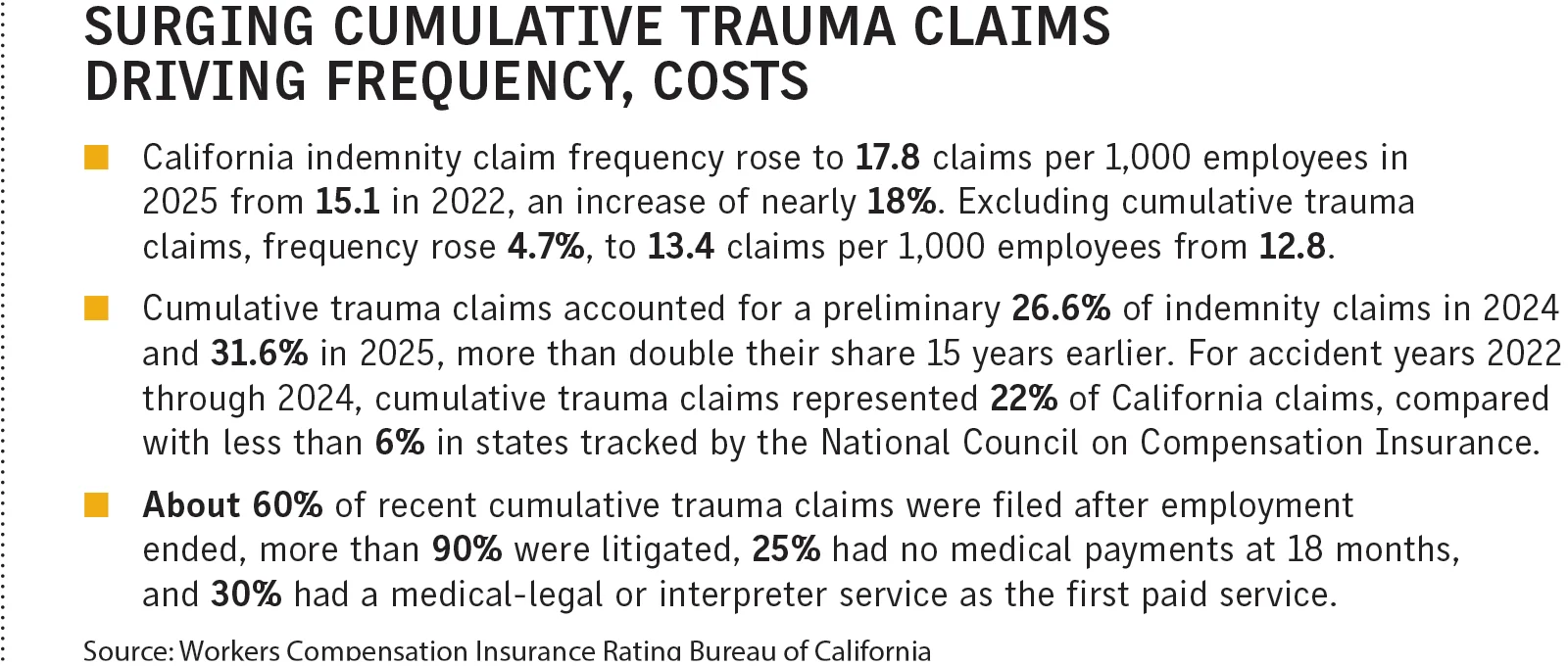
Surge in Cumulative Trauma Claims
Recent data indicates a significant escalation in cumulative trauma claims in California, reshaping the dialogue around workers' compensation. These claims, alleging injuries stemming from repetitive actions in the workplace rather than a single incident, have become a dominant factor in the surge in claim frequency, leading to heightened medical-legal costs and litigation rates.
Impacts on Insurers and Employers
The Workers Compensation Insurance Rating Bureau of California reports deteriorating financial conditions for insurers, with the projected accident-year combined loss and expense ratio climbing from 124% in 2024 to 127% in 2025. This rise marks the second consecutive year through 120%, indicating growing fiscal pressures in the industry. Meanwhile, written premiums have stabilized around $15.6 billion, with the average rate dropping to $1.56 per $100 of payroll—the lowest level observed in over half a century.
The California Department of Insurance has responded with rate adjustments, approving a 6.6% average advisory pure premium increase effective September 1, 2026, following an 8.7% increase the prior year. Despite these adjustments, the advisory pure premium rates remain significantly below the 2014-2015 peak by 46%.
The Debate on Claim Denials
At a recent conference, the contentious issue of claim denials emerged. Adam Dombchik, a managing partner at a Los Angeles law firm, pointed out that cumulative trauma claims are often denied within a brief 14 to 21-day window, typically without thorough investigation. He urged employers to recognize and approve more obvious cases early, particularly those involving long-tenured employees, rather than forcing these claims into extensive legal delays.
Conversely, Scotty Benton from Sedgwick defended the process of denial, stating that each claim is evaluated individually with documented reasons guiding any decisions made. He highlighted that delays are often tied to the medical-legal system's performance, where insurers struggle to obtain qualified evaluations within the mandated timeframe for decision-making.
Challenges in the Evaluation Process
The complexity of cumulative trauma claims often leaves employers at a disadvantage. Jeff Adelson of Bober, Peterson & Koby pointed out that many claims result in dismissal due to insufficient information at the onset. Unlike acute injuries, cumulative trauma claims often surface only when a worker formally declares their condition, typically long after the onset of symptoms. The tight 90-day timeline for accepting or denying a claim pushes employers to deny claims when critical details, like prior reports of pain or missed work, remain unverified.
Despite initial denials, the pathway to claim approval is still viable. Depositions and discovery phases may lead employers to accept claims when compelling medical evidence surfaces post-denial, emphasizing that outcomes largely depend on the medical evidence presented.
Systemic Issues Affecting Claim Outcomes
The recurring trend in California, as emphasized by Sure Log, revolves around the low threshold for demonstrating compensability in cumulative trauma cases. The existing statutory framework only requires that employment be a contributing factor to a condition, making it easier for these claims to be filed, especially by long-serving employees.
Moreover, California's 90-day denial rule incentives insurers to outright reject claims to steer clear of the presumption of compensability that could arise if they miss the deadline. Another layer of complexity is added by the state's post-termination defense, which often restricts claims after employment ends, except when the date of injury is established post-termination. Many cumulative trauma claims fall into this category, prompting employers to deny claims leveraging this legal maneuver.
Financial Implications of the Claim Increase
The rise in cumulative trauma claims bears significant financial implications. Data reveals that medical-legal services associated with these claims surged 38% from 2020 to 2024, while the allocated loss adjustment expenses have also seen a steeper increase, now averaging $13,860 per indemnity claim in 2025. Notably, a staggering 25% of cumulative trauma claims do not entail any medical payments during the first 18 months, and around 22% linger unresolved five years later.
Benton suggests that a broader reform of the entire system may be required to mitigate this trend rather than relying on individual claim resolutions, prompting a preparation for the sustained impact of cumulative trauma claims on insurance costs over the coming years.
Growing Trends and Regional Variations
A report from the California Workers' Compensation Institute sheds light on the broader trends driving claim increases beyond simple workforce growth. It delineates that cumulative trauma claims constituted 16.5% of all California workers' compensation claims in 2025, a steep rise from just 9.1% in 2018, predominantly occurring after 2021.
This increase reflects real shifts in filing patterns rather than a surge in repeat claims by individual workers. The data indicates that approximately 87% of the claim increase is attributed to new filings, though the proportion of multiple claims per worker did see a rise as well.
Interestingly, Southern California law firms have dramatically increased their involvement in cumulative trauma cases, representing 79% of such claims against Northern California employers in 2025, a stark contrast to 2019 when they accounted for just 23%. This shift has paralleled the uptick in remote hearings prompted by the COVID-19 pandemic, potentially allowing workers greater access to legal representation.
Regionally, Los Angeles continues to lead in cumulative trauma claim rates at 22.9% in 2025, while the Inland Empire and Orange County area experienced the most significant increase, jumping 10 percentage points to 19.8%. Such trends underscore the broadening impact of cumulative trauma claims across areas traditionally less affected and highlight the urgency of addressing the underlying systemic issues contributing to their rise.
Discussion
Sign in to join the discussion.