A Tennessee case underscores the critical need for precise job descriptions to facilitate effective return-to-work decisions in workers' compensation claims.
A recent Tennessee workers' compensation case has highlighted a persistent challenge faced by claims professionals: treating physicians often lack a comprehensive understanding of the physical demands associated with a worker's role. This disconnect frequently leads to misinformed return-to-work decisions, complicating the recovery process for injured employees.
The case, Beckman v. Manheim Tennessee LLC, featured a workers' comp judge awarding temporary disability benefits after determining that the treating physician misjudged the physical requirements of the claimant's job. This failure stemmed from insufficient clarity regarding the essential duties associated with the position.
Experts in workers' compensation, such as Steve Dadio, senior director of vocational recovery services for Paradigm, view this as a building problem. He emphasizes, “Doctors need a clear document outlining the physical demands of a job; without it, they rely on what the injured worker tells them or what they assume.” This situation exposes a larger issue where inadequate documentation leads to litigation.
Tammy Bradly, senior director of clinical strategy and market insights at Enlyte, reinforces this perspective, noting that many employers mistakenly believe that standard job descriptions provide all the necessary information for physicians. However, these descriptions often overlook critical details about essential functions and physical demands tied to specific tasks.
Dadio recalls a clear example: an outdated job description for a certified nursing assistant prohibited her from lifting 100 pounds. Upon inspection, it became evident that due to technological upgrades, mechanical patient lifts now facilitated this task, allowing her to return to work the very next day. Such outdated documents signal potential failures in return-to-work programs.
Irina Simpson, executive vice president of workers' compensation for Gallagher Bassett, points out that job descriptions need regular updates. Many roles have evolved due to advances in technology and ergonomic practices, yet associated documentation often remains stagnant. To combat this, some employers augment written descriptions with visual aids such as photographs and videos to provide a clear picture of daily job functions.
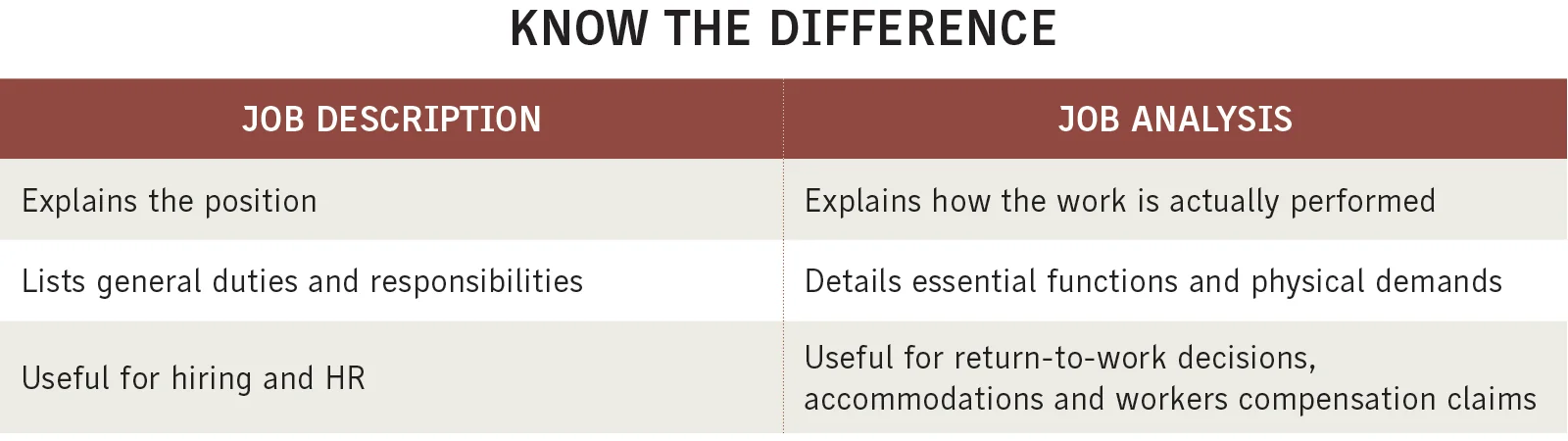
However, even with enhanced documentation, communication channels can break down. Adjusters may not secure the necessary job information, and medical providers might receive incomplete details. There’s also confusion between job descriptions and job analyses, which serve distinct functions. Nesha Courtney, national product manager for advocacy, disability, and return-to-work services for Broadspire, notes the importance of maintaining detailed job analyses that break down physical components.
Experts commonly urge that detailed job and physical demands analyses be established well ahead of potential injuries. Timely and accurate information-sharing is essential once a claim is made, preventing vague restrictions from physicians that complicate the accommodation of injured workers. “If you say light duty, what does that mean?” asks Simpson, highlighting the challenges posed by ambiguous directives.
Another example surfaced when Courtney assessed a physician's note that simply stated "sedentary work" — a term that can hold various interpretations. To mitigate confusion, employers should maintain comprehensive lists of available modified-duty tasks for injured employees returning to work.
If miscommunication arises, it can often escalate to litigation. Jeff Adelson, a partner with Bober, Peterson & Koby, reiterates that the quality of the information physicians receive directly impacts their decisions. He recalls cases where rigorous descriptions of physically demanding jobs at a distribution center turned out to be outdated—modern automation had significantly changed the tasks.
Misunderstandings surrounding job functions can leave physicians making decisions without the complete context of a worker’s actual duties, as Tiffany Speers, president of the California Applicants’ Attorneys Association, notes. “I don’t think the right hand knows what the left hand is doing when it comes to interactions with doctors,” she comments, reflecting frustrations within the industry.
Embracing Technology to Bridge the Information Gap
Emerging digital tools are offering workers' compensation professionals new ways to address the long-standing issue of ensuring that treating physicians have a clear understanding of employees' job functions before making return-to-work recommendations. While technology cannot supplant the importance of communication, advancements like digital job analyses, videos, and artificial intelligence (AI) applications are making it increasingly feasible to connect employers, adjusters, and medical providers.
Employers are increasingly adopting visual aids and predictive analytics alongside traditional written job descriptions to enhance the clarity of job demands. Simpson points out that AI tools may one day analyze work restrictions and support return-to-work decisions by recommending accommodations based on physician assessments.
Moreover, technology is improving data sharing among claims organizations and medical providers. Beth Burry Jackson, head of managed care for Sedgwick, notes that the best claim outcomes are typically achieved when issues are promptly addressed. Electronic medical records and secure information exchanges streamline communication, enabling claims professionals to relay job demands to physicians more efficiently and consistently.
Discussion
Sign in to join the discussion.